Downtown Las Vegas “Glitter Gulch”

July 5, 2011

Fremont Street Experience “Glitter Gulch” (c.1999)
Located in downtown Las Vegas, also know as “Glitter Gulch” or the newly renamed Fremont Street Experience, this four block canopy is actually the largest lighted outdoor sign in the world.

Click on the small thumbnail photos to view the 360° panoramic photos in high definition.  All photos and were taken in summer of 1999

Click for Hi-res 360 photo
Plaza Hotel and Casino (originally the Union Plaza) across the street, Las Vegas Club and The Golden Gate (oldest casino in Las Vegas-1906 Located at 1 Fremont St.) with the famous $.99 Shrimp Cocktails.

Click for Hi-res 360 photo
The Golden Gate, Golden Goose (Girls of Glitter Gulch- strip club), Las Vegas Club and the Coin Castle.

Click for Hi-res 360 photo
The Golden Gate, Golden Goose (Girls of Glitter Gulch), Las Vegas Club and the Coin Castle.

Click for Hi-res 360 photo
Sassy Sally’s, Pioneer Club, Horseshoe, and the Golden Nugget.

Click for Hi-res 360 photo
Binion’s Horseshoe, home of the World Series of Poker, and the Elegant Golden Nugget. Note: in 2004, the hotel was sold, rename to Binion’s Gambling Hall and Hotel and the rights to the World Series of Poker was sold to Harrah’s.

Click for Hi-res 360 photo
The 4 Queens, Fremont, Horseshoe, and the Golden Nugget

Click for Hi-res 360 photo
The 4 Queens, Fremont, Horseshoe, and the Golden Nugget

Click for Hi-res 360 photo
Downtown Las Vegas in front of the Four Queens and the Fremont

Click for Hi-res 360 photo
The 4 Queens, and the Fremont Hotel

Click for Hi-res 360 photo
Fitzgerald’s and Shopping

Click for Hi-res 360 photo
Western Village and Trader’s Bill

Posted by: Webmaster      catagory Downtown comments Leave a comment

Las Vegas 360 Panoramic Photos of Las Vegas

July 4, 2011

Click any of the photos for a 360° hi-res view of the Las Vegas Strip.

Welcome to Fabulous Las Vegas Sign
Welcome to Fabulous Las Vegas historic sign, the beginning of the famous “Strip”, Las Vegas Blvd. South. (c. 1999)

Glass Pool Inn aka The Mirage
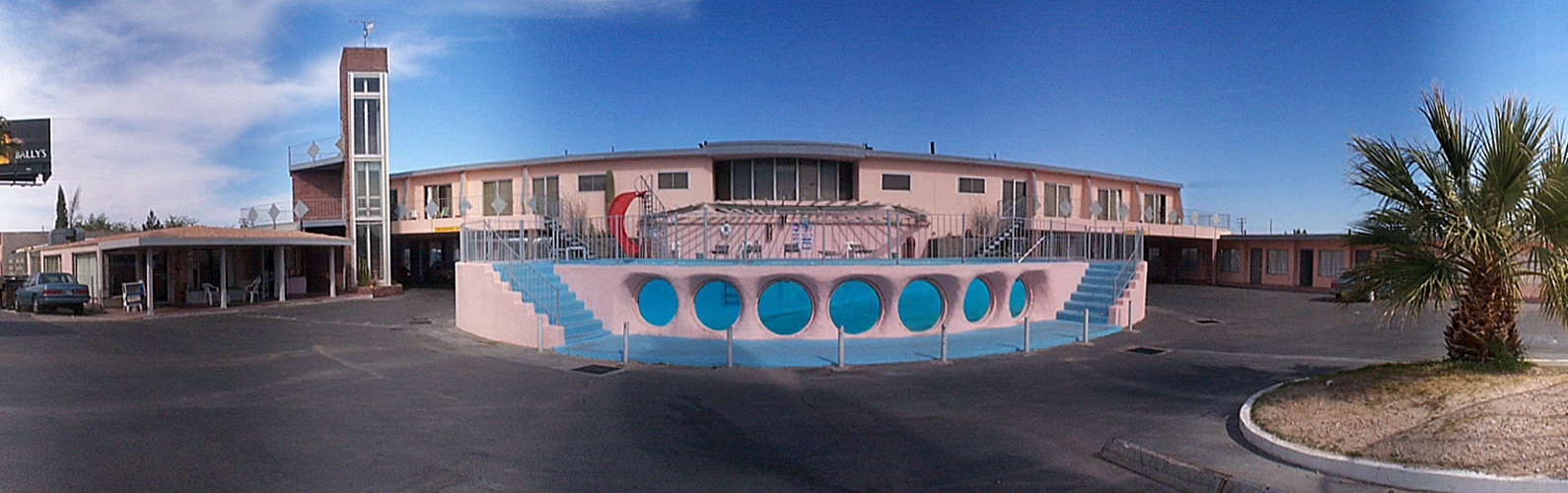
The Glass Pool Inn 1950’s style motel on the south end of the Strip, with the coolest swimming pool. Note: The Motel was renamed in 1988 from “The Mirage” when Steve Wynn’s Mirage Hotel Open. Motel and pool was demolished in 2004, only the sign remains. (photo. 1999)

Click for Hi-res 360 Photo
The Glass Pool Inn and the Mandalay Bay Hotel in the the background. (c. 1999)

Click for Hi-res 360 image
Mandalay Bay (includes a Four Seasons Hotel) and the Luxor Hotel opposite.  Mandalay Bay includes the legendary House of Blues which features nightly entertainment.

Click for Hi-res 360 Photo: The Luxor and Excalibur Hotels
Front Entrance to the Luxor Hotel. Largest pyramid hotel in the world. The Luxor (2,526 rooms) and Excalibur (4000 rooms) Hotels

Click for Hi-Res 360 photoLocated in the front of the Excalibur Hotel & Casino looking at the New York New York Hotel.

Click to view hi-res 360 photo
On the pedestrian walkway between the Tropicana and the Excalibur

Click to view hi-res 360 photo
Located in front of Tropicana, SE Corner of Las Vegas Blvd. (Strip) and Tropicana Ave.

Click to view hi-res 360 photo
Located in front of the MGM Northeast Corner of Las Vegas Blvd.

Click to view hi-res 360 photo
Located on the walkway between New York New York and MGM.

Click to view hi-res 360 photo
Located in front of New York New York, Northwest corner of Las Vegas Blvd. (Strip) and Tropicana Ave.

Click to view hi-res 360 photo
Located on the walkway between NY NY and Excabilar Hotel & Casino.

Click to view hi-res 360 photo
Allstar Cafe located next to the MGM Grand Hotel includes GamesWorks, M & M World and Coke Cola Plaza. Note: All Star Cafe, a sports-themed restaurant developed by Andre Agassi and five athlete partners, closed in 2000. Replaced with cheesy-Generica fast-food.

Click to view hi-res 360 photo
Monte Carlo Hotel Located next to the New York New York Hotel.

Click to view hi-res 360 photo
Monte Carlo Hotel on the Left and Polo Towers (Timeshare on the Right).

Click to view hi-res 360 photo
Polo Towers on the East Side with the Boardwalk Hotel & Casino. Note: Boardwalk Hotel & Casino closed in 2006. It was imploded on May 9, 2006 to make way for City Center.

Click to view hi-res 360 photoConstruction of the Aladdin (c.1999) -now Planet Hollywood and the Paris Hotels looking north. The Harley Davidson Cafe is located on this corner, it is the building with the motorcycle crashing through the front entrance. Note: Across the Street, everything was removed and City Center now stands.

Click to view hi-res 360 photo
Construction of the Aladdin-aka Planet Hollywood (c.1999) (foreground) and Paris (tower).

Click to view hi-res 360 photo
The Bellagio looking across the Lake Look toward Caesars Palace.  Note: Bellagio
opened October 15, 1998. It was the former site of the Dune’s Hotel that operated from May 23, 1955 to January 26, 1993 imploded on November 25, 1997

Click to view hi-res 360 photo
Construction of the Aladdin and the Paris Hotels (c. 1999).  Note: The Aladdin opened April 1, 1966 and closed November 25, 1997. The hotel was imploded on April 27, 1998 and reopened on August 18, 2000. On April 17, 2007, the hotel was renovated and renamed to Planet Hollywood Resort and Casino.

Click to view hi-res 360 photo
The Bellaigo Hotel and Casino across the lake.

Click to view hi-res 360 photo
Another view of the  Bellaigo Hotel and Casino across the lake.

Click to view hi-res 360 photo
Bally’s Hotel and Casino on the corner of Las Vegas Blvd. and Flamingo Road.

Click to view hi-res 360 photo
Bally’s Hotel and Casino. Note: Bally’s was formerly the MGM Grand Hotel and Casino, the casino burned in Las Vegas’ worst fire on November 21, 1980, killing 85 guests and employees. The MGM Grand was sold in 1985 and renamed to Bally’s.

Click to view hi-res 360 photo
Barbary Coast (c. 1999) and Bally’s Entrance at Flamingo Road and Las Vegas Blvd. Note: The Barbary Coast (March, 1979-February 27, 2007)  The hotel and casino were rebranded as Bill’s Gamblin Hall and Saloon.

Posted by: Webmaster      catagory The Strip, Vegas comments 3 Comments

Las Vegas History

Las Vegas History

The Glass Pool Inn -Demolished in 2006. It was called Mirage Motel until 1988 and changed names due to The Mirage opening down the Strip in 1989.

Las Vegas is a relatively young town but its history can be traced all the way back to 1829, when Antonio Armijo lead a party of 60 on the Old Spanish Trail to Los Angeles. While the caravan camped about 100 miles northeast of the present site of Las Vegas, a scouting party set out to look for water. Rafael Rivera, a young Mexican scout who left the main party and headed due west over the unexplored desert, discovered an oasis. The abundance of artesian spring water he found here shortened the Spanish Trail to Los Angeles by allowing travelers to cut directly through rather than around, the vast desert. Spanish traders who used this route were thankful for the shortened trip and they named this convenient desert oasis Las Vegas Spanish for “the Meadows”.

John C. Fremont was the next visitor to the Las Vegas Springs. In 1844 he led one of his many explorations to the Far West. He is still remembered today and his name graces one of the most spectacular streets in Las Vegas, Fremont Street, located downtown.

Ten years later Mormon settlers were sent by BrighamYoung from Salt Lake City to colonize the valley. They built a 150 square foot adobe brick fort, part of which still stands today as the oldest structure in Las Vegas and is appropriately named the Mormon Fort. The Mormons spent two years here before the harsh desert defeated their ambitions. By 1857 the fort was abandoned.

Things really didn’t start happening for Las Vegas until 1904, when the San Pedro, Los Angeles and Salt Lake Railroad laid its tracks through the Las Vegas Valley. The Railroad purchased prime land, bought the water rights and surveyed a town site for its railroad servicing and repair facilities. In 1905, the railroad held an auction and sold 700 lots. Las Vegas became a small watering stop with a few hotels, stores, a saloon and a few thousand residents.

When the government appropriated $165 million for the Boulder Canyon Project in 1928, Las Vegas received its first wave of residents. Thousands of Depression weary job seekers came to help build the world’s largest gravity dam, 40 miles from Las Vegas, now named Hoover Dam.

In 1931, construction of the dam began and the Governor of Nevada, Fred Balzar, approved the “wide open” gambling bill that had been introduced by a Winnemucca rancher, Assemblyman Phil Tobin. Up until that time gambling was outlawed in Nevada.

Hoover Dam

As people flocked to the area to work on the Boulder Dam Project the federal government didn’t want the workers to be distracted by the temptations of Las Vegas so they created a separate government town to house them, Boulder City. Gambling was illegal in Boulder City and it still remains the only community in Nevada where gambling is against the law.

The country’s attention was focused on the dam as it was completed in 1935. The dam served as a magnet for federal appropriations, thousands of tourists and new residents and an endless supply of power and electricity. Also, as the country prepared for World War II. Tens of thousands of pilots and gunners trained at the Las Vegas Aerial Gunnery School, opened by the government on 3 million acres north of town. Today this property is home to Nellis Air Force Base and the Nevada Test Site.

By the early 1940s, downtown Las Vegas had several luxury hotels and a dozen small but successful gambling clubs. In 1941 a businessman by the name of Thomas Hull, who owned a string of motor inns in California, decided to open the El Rancho Las Vegas, just outside the city limits right off the highway from Los Angeles. The El Rancho had 100 motel rooms, a western styled casino, it was located right off the highway and had a large parking lot with an inviting swimming pool in the middle. The El Rancho’s quick success led to the building of another property down the road called the Last Frontier Hotel. Thus the Las Vegas Strip was born.

Posted by: Webmaster      catagory Vegas comments 1 Comment

Boulder City / Hoover Dam

Boulder City

Boulder City was built by the federal government to house the thousands of workers who were building the Hoover Dam project in the 1930s. In order to keep these workers away from the temptations of Las Vegas, Boulder City was founded and gambling was made illegal. This quaint town remains the only community in Nevada were gaming is still illegal.

Management and maintenance crews of Hoover Dam are now the predominant residents of Boulder City. This unique town is a vibrant community, with a movie theater, numerous gift shops, parks and a historic hotel. Call the Boulder City Chamber of Commerce for more information 702.293.2034

Hoover Dam
Hoover Dam- is one of the seven man-made wonders of the world. The dam is 727 feet high (70 stories) and 660 feet thick. Construction of the dam required 4.4 million cubic yards of concrete (which is enough to build a two lane highway from San Francisco to New York). In 1928 Congress appropriated $165 million in funds to build the Boulder Dam project for two purposes: flood control and the generation of electricity. Originally called Boulder Dam, it was renamed for Herbert Hoover, Secretary of Commerce, during the critical planning stages of the project. Completed in 1935, this gravity dam holds back the mighty Colorado River and forms the largest man-made lake, Lake Mead. Hoover Dam is located 40 miles from Las Vegas on Highway 93. Tours are available and they leave every few minutes from the exhibit building at the top of the dam. Regular Tours daily from 8-5:15pm Call (702) 293-8367



Lake Mead National Recreation Area
Lake Mead is the largest man-made lake in the country. It is created by Hoover Dam holding back the waters of the Colorado River. Its surface covers 229 square miles and its irregular shoreline extends 550 miles. Lake Mead is located off of Highway 93. The National Park Service can give you details on the lake’s recreational activities and facilities. (702) 293-8990


Posted by: Webmaster      catagory Boulder City-Hoover Dam, Off The Beaten Path comments Leave a comment

Valley of Fire

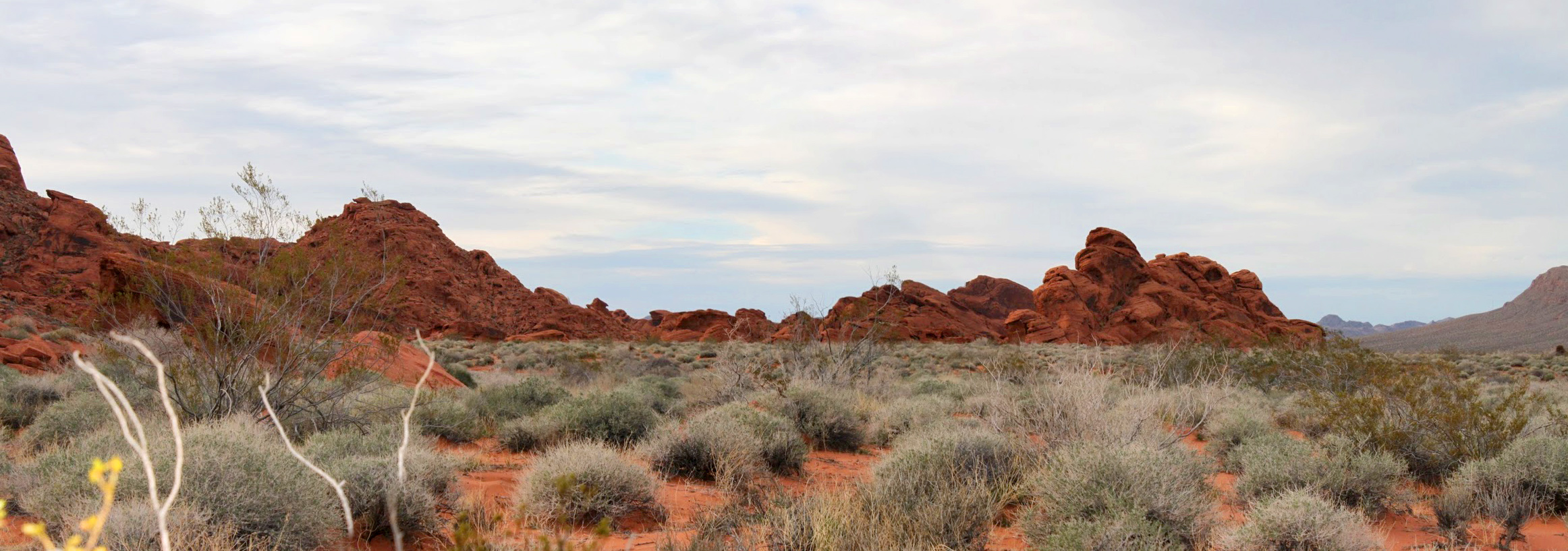
One of the most beautiful features of the desert are the brillant red rocks that are scattered throughout southern Nevada. These vivid hues can be best observed in the appropriately named, Valley of Fire.

Looking across the barren, hot, desert valley it is hard to believe that 600 milion years ago the entire area was under water. Animal and plant life was abundant here at that time and as the waters subsided over the next 400 million years the thriving ocean floor became a unique desert valley. The sandstone rocks vary in color from deep reds and purples to tans and whites and their unique formations have been formed by millions of years of erosion, wind and climatic change.

Some of the most interesting rock formations are the “Seven Sisters” which are seven unusal rock formations which stand in a row. They are remnants from the harsh erosion which has changed their shape over the years.

Ancient and Modern Man in the Valley of Fire

To look at this harsh desert landscape it is difficult to believe that ancient people once thrived here. Evidence of their lifestyle has been left behind in petroglyphic drawings. A few archaelogists believe that people lived here as long ago as 15,000 years although that assumption has been unproven most would agree that man was present here about 4,000 years ago. Small enclaves of families roamed and hunted in this area. Their main diet consisted of bighorn sheep and smaller game such as rabbits and tortoises. The first record of Europeans in the area was when the famous mountain man Jedediah Smith, who led the first party of fur trappers into the area in 1826. He was followed by Kit Carson in the 1840s. Just like a tale from an old western movie the Europeans and the Paiute people who had inhabited this area fought over the ownership of the land and its animals.

Mouse’s Tank

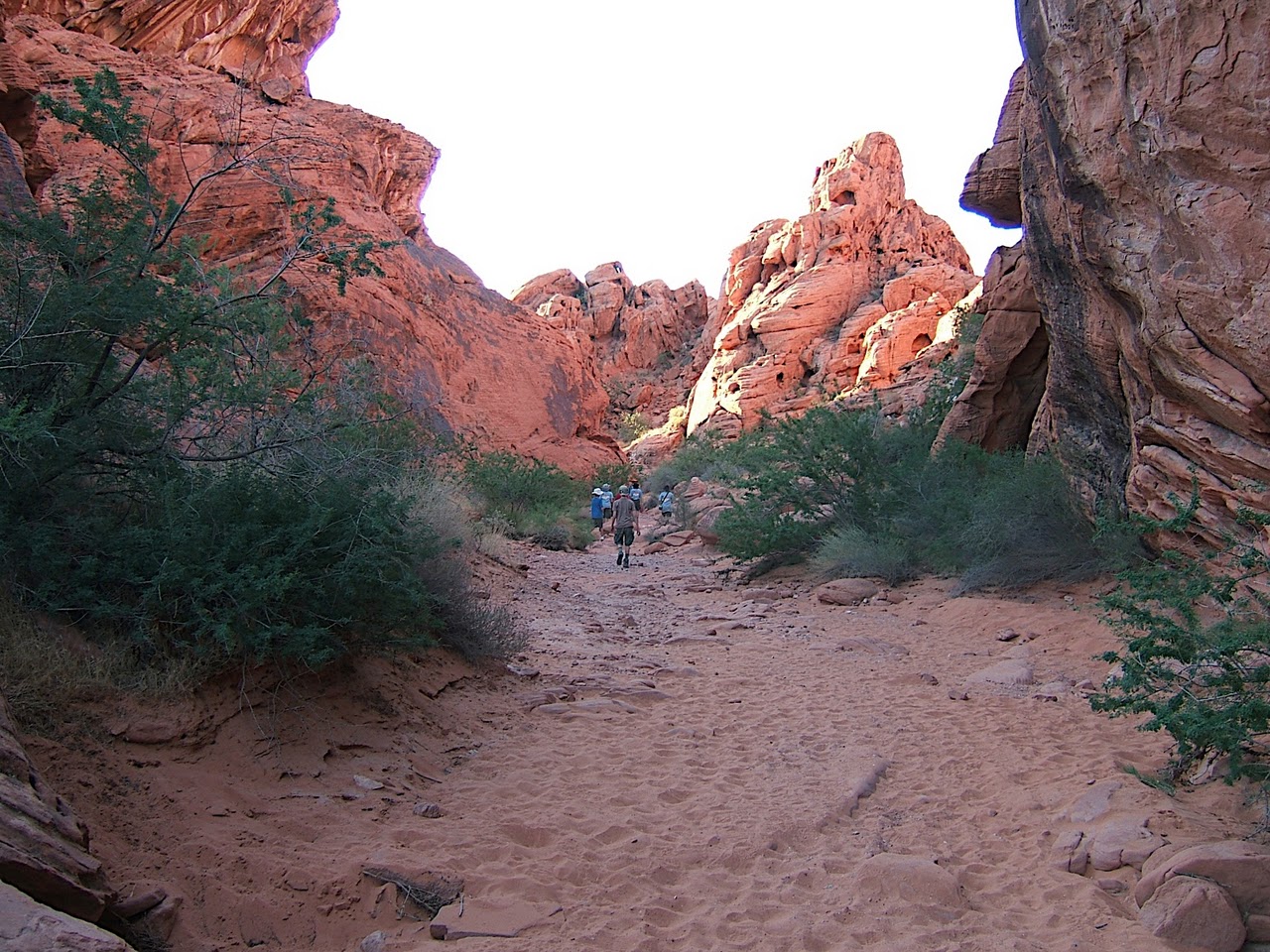
One of the greatest legends of the Valley of Fire is about a Paiute Indian named Mouse. Mouse was a known outlaw who worked on ferry that crossed the Colorado River. After a drunken episode where he shot up an Indian camp his employers fired him and dumped him off in Arizona. There, it is said, he killed two prospectors. A intensive search was conducted but Mouse could not be found. Apparently during these episodes Mouse would flee to the Valley of Fire to hide out. Here he would sometimes use “Mouse’s Tank”, a depression in the rocks that catches and holds rainwater for a time after storms. Mouse’s Tank is well hidden within the maze of rock formations on the Petroglyph Canyon floor, a perfect hideout for a fugitive. On July 11, 1897 a posse tracked Mouse near Muddy Spring and ordered him to surrender. Mouse would not give up and after a gun fight with the law Mouse was shot and killed.

On the trail to Mouse’s Tank

Valley of Fire located 55 miles from Las Vegas it spans more than 37,000 acres. Nevada’s first state park, composed of stunning red sandstone formations and a wealth of Indian artifacts and petroglyphs. A vistors’ center provides information on the park’s history and geology. The Lost City Museum is located nearby. Valley of Fire Vistor Center: (702) 397-2088.

Posted by: Webmaster      catagory Off The Beaten Path, Valley of Fire comments Leave a comment